KnownFor / In detail
KnownFor in detail
What you get, pricing, our promises and the FAQ, plus detailed explanations of AI answers and security.
What you get
With the inspection, you get where you stand and the order of fixes. After the fixes, we measure again and show you before and after.
The cover alone tells you where you stand and what to decide this week.
Market position (sample)Gemini & ChatGPT · 20 answers, last 7 days
- 30%Your name came upCompetitor A: 68%
- 0%Your site was the sourceCompetitor A: 40%
- 4thof 5 companiesby share named
RecommendsNeutralNegativeCircle size = times named
Where you stand among companies in your industry.
The further right, the more often AI names you; the higher up, the more often it cites your site. The sample company is named but never cited, 4th of 5.
On a subscription, this position and what to fix to move up arrive every week.
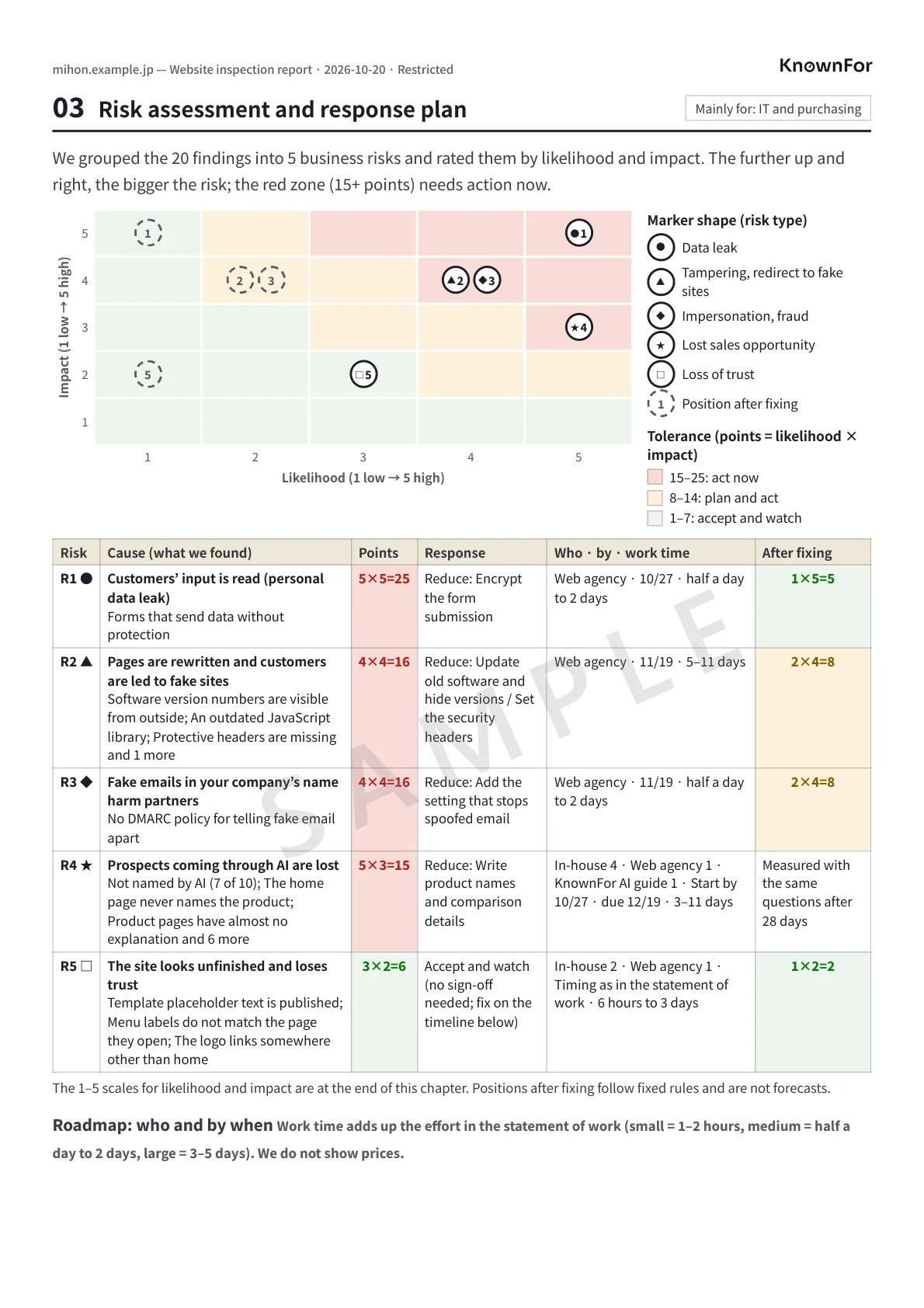
The monthly inspection report (sample company)
- Where you stand, and what to decideA one-line conclusion on the cover, ready to share inside your company.
- The order of fixes, and the articles AI readsDown to whether you appear in the comparison articles and reviews AI reads most.
- A statement of work for your web agencyWhat to fix, who does it and by when, one item at a time.
One line of the statement of work (sample)
| Task | Severity | Who | By when |
|---|---|---|---|
| Version of an old component (JavaScript) | Serious | Web agency | This week |
To take it to the fixes, “Get ready up to Level 4”; to keep watching afterwards, a monthly plan (from JPY 40,000/month, excl. tax). Order an inspection
[KnownFor] Your monthly inspection report is ready (www.example.com)
Sample Company Inc.
KnownFor has finished this month’s inspection report (AI answers, security and real incidents matched to your site). You do not need to do anything to receive it.
Critical 1Caution 2Fixed 3
To decide: AI left you off the shortlist in 7 of 10 questions. Add your product names, and the details buyers compare, to your site.
Open the inspection report →
Are your fixes working? See it in the numbers.
Sample data. Results are not guaranteed (about 30 seconds, with narration and subtitles).
Why you can’t see it
How AI introduces you
never shows up in rankings or analytics.
Buyers ask AI for options before they contact you. But what AI said about you is not in any number you have.
64.1%
Among people in Japan who chose a B2B service, the most common place to start research was AI search or AI chat (search engines: 55.0%).
Source: Nile Inc. (July 2026, 329 people in Japan who had chosen a B2B service, multiple answers)
So if the answer is wrong, you will not notice. A price from before your last update, a campaign that has ended, a comparison site’s words: AI gives these to buyers as its description of you. And if you are not on the shortlist, you are out before anyone compares.
How does AI describe your product?
Sample reportSample company
- 3/10 questionsYour name came up
- 0/10 questionsYour site was the source
What changes
See how AI introduces you,
every week.
Before: buyers compare you in AI, and you cannot see what it says
Know whether AI recommends you
Every week we ask AI the questions buyers are likely to ask, and record whether you were named, whether you were described correctly, and how competitors did.
Before: you do not know what to fix to get on the shortlist
One thing to fix, each week
We send what we found in the order to fix it. All you decide is which items to fix this week.
Before: you do not know how to brief your web agency
Ready to hand to your web agency
Each item comes with a statement of work: what to fix, who does it and by when.
Before: you fix something and cannot tell if it worked
See whether it worked, every week
We compare before and after with the same questions. We do not call an unclear change a result.
GEO maturity: 5 levels, each with its own AI guide
- Level 1ReadMamoru (AI)
- Level 2Read correctlyTadashi (AI)
- Level 3RecommendedMichi (AI)
- Level 4CitedShirube (AI)
- Level 5Driving actionMinori (AI)
Every inspection tells you your current level and the next step. Levels can go up and can also go down. Your guides are AI, not human staff, one for each level. More about the 5 levels →
KnownFor in one minuteWith narration and subtitles · figures on screen are samples
What you do
All you decide is
what to fix this week.
Checking, finding problems, ordering the fixes and writing the statement of work: KnownFor does all of this every week. No screens to operate and no expertise needed. The screens are tools for those who also want to inspect on their own.
Steps 3–6 repeat every week. Security is checked every day; we only email when something gets worse.
That is all you do. If you sign up with a company email on the same domain as the website, no ownership step is needed to sign up. The attack entry-point check (website ASM) starts from the inspection after you place a verification mark (DNS, file or page tag) from your KnownFor screens.
Want us to make the fixes too?
KnownFor can carry out the order of fixes in the report on your behalf. We change site settings or content only after your approval. We quote based on how your site is built and how much needs doing.
Pricing and sign-up
Start with an inspection to see where you stand.
Take it all the way to the fixes as a project with an end.
No setup fee. The inspection and the project to the fixes are one-time payments (card or bank transfer); monthly plans have no minimum term. Customers outside Japan pay by credit card as standard. All prices exclude tax.
Start with one inspection to learn where you stand and the order of fixes. To take it all the way to the fixes, choose one project with an end. Choose a monthly plan when you want to keep watching after things are in order.
1Start with an inspectionWhere you stand and the order of fixes
2All the way to the fixesOne project with an end
Getting ready to be recommended and cited by AI, as one project with an end.
Starting from where the inspection shows you stand, we deliver drafts of the actions to take, measure again at set times, and send you the results side by side with before. Your web agency can use the drafts as they are. It is not a monthly plan: it has an end.
| What you get | Delivered | Re-inspection | Typical time | Price excl. tax |
|---|---|---|---|---|
| Inspection (Level 1) | Inspection report, statement of work and draft fix files | Security only, once more within 60 days of the inspection (free) | The inspection can be ready the same day; security fixes take about 2 weeks (depends on your contractor) | JPY 30,000 |
| To Level 2 (actions and re-inspection) | A list of your facts (contacts, phone numbers, addresses, opening hours and so on), draft fact paragraphs, and a list of outside directories to correct | Starts with the inspection; about 3 weeks after your fix, we ask AI again and send the results side by side with before | Starts with the inspection; we ask AI again about 3 weeks after the facts are fixed | JPY 40,000 |
| To Levels 3–4 (actions and re-inspection) | Draft page outlines and items to write, places to add numbers and sources, outside directories and industry lists to be listed in, and steps to connect GA4 | Starts with the inspection; using the inspection as the baseline, one more inspection including AI about 3 months after you publish the pages (about 4 months from the inspection when the fixes take about 4 weeks) | Starts with the inspection; about 4 weeks to write and publish the pages; measured about 3 months after publishing | JPY 80,000 |
What we promise
- Delivering the actions up to the goal you chose (statement of work and drafts)
- Re-inspecting at the set times and delivering the results side by side with before
- Inspecting the same scope again free of charge if an error is found
What we do not promise
- That your level will go up (it depends on AI models and outside articles, and effects take months to show)
- When your contractor makes the fixes (that depends on your contract with them)
- Doing the fixes themselves (KnownFor does not enter your site)
You can also add only To Level 2 (actions and re-inspection) (JPY 40,000; the goal is “Get ready up to Level 2”). You order from your inspection order in your KnownFor screens once the report has arrived, at the prices shown here. With a card we start after payment; with a bank transfer, after the payment arrives. You can cancel until we deliver the drafts of the actions. To keep watching after the project ends, choose a monthly plan below.
3To keep watching after thatMonthly plans
Every plan delivers the same things. The only difference is how many days a week we ask AI about your company. After you sign up, there is nothing for you to operate. You can change plans later.
Included in every plan
- Weekly inspection, monthly reportChanges every week; the report matches real incidents and lists what to decide
- Daily security watchWe tell you right away when something gets worse
- Order of fixes and a statement of workWhat, who, by when. Hand it straight to your web agency
- 15 questions about your company asked to AITo two AIs (Gemini and ChatGPT)
- Where you stand among AI answers, side by side with your industry
- Drafts of page text and settingsWithin the usage you can use yourself
| Item | KnownFor Weekly | KnownFor 3x a week | KnownFor Daily |
|---|---|---|---|
| Monthlyexcl. tax | JPY 40,000 | JPY 100,000 | JPY 200,000 |
| Annual12 months at once, 2 months free | JPY 400,000/year | JPY 1,000,000/year | JPY 2,000,000/year |
| Days we ask AI about your companyAI answers change from day to day. The more days we ask, the more reliable the numbers and the less likely we miss a change | Once a week | 3 times a week | Daily |
| Suits sites that | Change a few times a month at most | Change often with new products or campaigns | Lose money quickly from errors in bookings, prices or contact points |
| Sign up |
One contract covers 1 site and up to 10 products or services. The usage you can use yourself on the screens (inspections, drafts, consultations) is 2.5 times KnownFor Weekly for KnownFor 3x a week and 5 times for KnownFor Daily (even KnownFor Weekly covers about 20 inspections that include AI a month).
Subscriptions require agreeing to data sharing (without it, the monthly fee is 1.5×). Even if you use up your own usage, the weekly automatic inspections do not stop. Buying more, daily limits and other details are under “Fine print” below. The security check covers the first three steps of an attack: recon, pinpointing and open entry points (penetration testing is in preparation as KnownFor’s next stage).
Want to check first that KnownFor can read your site? (optional)
Before you sign up, we check that KnownFor can read your site (some sites cannot be read because of their security settings). You can check it on the spot with the check below.
Fine print (contract unit, annual billing, pricing without data sharing and more)
All prices exclude tax. Subscriptions (KnownFor Weekly, KnownFor 3x a week and KnownFor Daily) cover 1 site and up to 10 products or services per contract (beyond that, each further 10 is billed at the same monthly fee again; another company or website is a separate contract), billed either monthly (no minimum term; cancel any time) or annually (12 months paid at once, 2 months free; no refund if you cancel partway, and you can stop the next year’s renewal). Every plan measures all GEO maturity Levels 1–5. Your usage covers inspections that include AI (security check and GEO together, or GEO only), page drafts and consultations with your agents, and resets on the 1st of each month. KnownFor 3x a week gives 2.5 times and KnownFor Daily 5 times the usage of KnownFor Weekly (as a guide, even KnownFor Weekly covers about 20 inspections that include AI a month; how much one task uses depends on its size). Inspections that include AI are limited to 3 a day to keep the queue moving. We let you know on screen and by email before you run out, and an admin can buy more (JPY 10,000, JPY 30,000 or JPY 50,000, or any amount from JPY 5,000; excl. tax; usable for 6 months from purchase; non-refundable). Once that is also used up, work stops until the 1st of the next month. Security-check-only inspections and security-only rechecks do not use your usage and have no limit on the number of runs. Checks of site-wide settings (headers, certificate, email settings, CMS version and so on) apply to the whole site regardless of page count. Page-by-page checks cover the important pages first, up to 500 pages, and the price does not change with page count. We list the sections and page counts we did not read. The price without data sharing (1.5×; annual KnownFor Weekly JPY 600,000, KnownFor 3x a week JPY 1,500,000, KnownFor Daily JPY 3,000,000) applies to subscriptions only. Sign-up without consent is being prepared. For industry observation (every plan): if we already observe your industry, you can see results from day one. Even for a new industry, KnownFor sets up observation and shows your first results once enough AI answers are in. We don’t bill until observation starts. The number of days we ask AI is set by the plan (once a week, 3 times a week or daily, on different days), so you don’t need to choose any settings.
Why it costs what it does, and how we handle data.
KnownFor keeps this price by sharing observations among companies in the same industry and using the collected records for market statistics. For that reason, ongoing company contracts (KnownFor Weekly, KnownFor 3x a week and KnownFor Daily) assume agreement to data sharing (local government fiscal-year contracts are used, without a separate consent step, only in statistics that do not identify the local government).
What we use
- Your site’s public pages, and changes to them
- Whether AI’s answers named you, cited you, and how they described you
- The competitor names you register, and questions that mention no names
How we use it
- We turn it into statistics that can’t be traced to any company, and use them for market observation and for analyzing “what fixes work”
- These statistics are also used to review KnownFor’s assessment rules and criteria. They are never used to train generative AI models
What we don’t use
- Search Console and Google Analytics data
- Information about human visitors
- Using your page text or the AI answers themselves to improve AI
If you do not agree, the monthly fee is 1.5× (KnownFor Weekly JPY 60,000/month, KnownFor 3x a week JPY 150,000/month, KnownFor Daily JPY 300,000/month, excl. tax). Sign-up without consent is being prepared. The one-time scan needs no consent. Details are set out in the Terms of Service and the Privacy Policy.
Where KnownFor sits among other options (chart and table)
Where KnownFor sits
AI answers and security on one map, through to confirming the fix worked.
Fix it and confirm it worked
- Security and AI answers measured on five GEO maturity levels
- Work instructions and page drafts, through to the fix
- After 28 days: “it worked”, “it went down” or “can’t confirm”
- Your whole industry, observed with the same questions
- Company CWeb app scanners (DAST)Test the running app from outside
- Company DEASM platformsFind public assets, including forgotten ones
- Company EVulnerability management suitesScan assets already on your list
- Company FAI visibility trackersTrack mentions in AI answers
- Company GEnterprise AEO platformsTracking plus recommendations and content tools
- Company HSEO suites’ AI add-onsAI visibility added to SEO tools
Find and measure
KnownFor’s own placement, based on information companies published as of October 2026. Positions reflect each type’s main purpose, not a ranking. Companies A–H are examples of each product type, not specific companies. Some products in the lower row also suggest fixes or re-test them. EASM platforms look broadly across all your assets, and scanners and pentests test in depth. KnownFor looks at your contracted website, from the attack entry points (the attack entry-point check) to the AI answers. They work together.
| AI visibility trackers | Enterprise AEO platforms | Web app scanners and pentests | EASM platforms | KnownFor | |
|---|---|---|---|---|---|
| Main purpose | Measure mentions in AI answers | Measure AI visibility, then suggest what to do | Test a running app or system for weaknesses | Find internet-facing assets, including unknown ones | See how you look in AI and the gaps visible from outside, together |
| Position in AI answersNamed, cited, how described | Yes | Yes | — | — | Yes: our observatory observes each industry daily and shows it summarized week by week |
| Comparison within your industry | Usually, against competitors you choose | Usually, against competitors you choose | — | — | Yes, same questions across the industry |
| AI misdescription and impersonationWrong prices or details, similar-named sites | Depends on the product | Depends on the product | — | — | Yes |
| How to fix | Depends on the product; often left to you | Recommendations and content tools | Countermeasures for each weakness | Depends on the product | Yes: fixes for each page, with text to hand to your web agency |
| Gaps visible from outside | — | — | In depth, including active tests | Broadly, across public assets | A check of the contracted site (security daily, report monthly), plus the attack entry-point check (website ASM) once the owner is verified |
| Price guide | From about USD 30 to a few hundred/month | From about USD 100 to 400/month; enterprise tiers quoted individually | Scanners by subscription; pentests usually quoted by scope | Usually quoted; often by number of assets | KnownFor Weekly JPY 40,000/month, KnownFor 3x a week JPY 100,000/month, KnownFor Daily JPY 200,000/month, one-time inspection JPY 30,000 (local governments: start with a JPY 33,000 detailed report, incl. tax; fiscal-year contract from JPY 440,000 incl. tax) |
| Language and payment | Mostly English screens; USD or EUR | Mostly English screens; USD | Mostly English screens; subscription or quote | Mostly English screens; usually a quote | Japanese, English and Korean screens; JPY; bank transfer (invoice) or card |
A guide by type, based on information companies published as of October 2026. Products vary. For your website, KnownFor covers part of ASM (the attack entry-point check). It works alongside web app scanners, penetration tests and EASM platforms.
Not included
- Publishing to your live site and the final fact check (KnownFor provides work orders and draft copy; people confirm the figures and track record and write to the live site)
- Negotiating listings on comparison media and review sites (digital PR)
- Calculating the contribution to sales or inquiries (ROI in yen)
- Any guarantee of rank or appearance in generative AI
Local governments in Japan sign a fiscal-year contract (tax included). Page for local governments (Japanese) →
Our promise
We promise only
what we can keep.
Not rankings or uplift figures, but what you keep in hand and what you can check.
What we promise
- The results for the scope we inspected, the order of fixes and a statement of work, delivered as a report (PDF).
- On an ongoing plan, we inspect automatically every week, email you what changed, and send the inspection report once a month (security every day; we only email when something gets worse). There is nothing for you to press.
- The weekly inspection compares before and after with the same questions, so you can see whether fixes closed gaps and worked.
- A single inspection can deliver the report as early as the day you sign up. Within 60 days of the inspection, you can have the security inspected once more, free of charge.
- If an error is found in a report, we inspect the same scope again free of charge.
- From sign-up to inspection, report and billing, everything runs automatically on screen. You never wait for a person to reply.
- Ongoing plans are not billed until observation starts. No minimum term; cancel any time.
What we don’t promise
- Publishing to your live site and the final fact check (KnownFor provides work orders and draft copy; people confirm the figures and track record and write to the live site)
- Negotiating listings on comparison media and review sites (digital PR)
- Calculating the contribution to sales or inquiries (ROI in yen)
- Any guarantee of rank or appearance in generative AI
- Writing to your site without your approval
- Inspecting another organization’s site (in KnownFor, only registered staff who belong to an organization can inspect that organization’s sites)
Case zero is our own site
On October 20, 2026 we applied the measures (company structured data, sitemap, llms.txt and articles) to knownfor.jp itself, and we keep observing it with the same questions. We will publish the before-and-after figures in our observation reports.
Market
We observe not only you but companies across your industry, with the same questions. The gap with competitors itself becomes the evidence
Inspection results for KnownFor’s own site
www.knownfor.jp · inspected automatically every week and shown here · 19 items visible from outside
Loading the latest inspection results…
This inspection covers only what is visible from outside and does not guarantee safety. The KnownFor screens (app.knownfor.jp) are behind login and are not covered.
Why security in an AI search tool?
Security is not the goal. It is the foundation.
A shopping mall gets its safety in order before it invites people in. The goal is to get chosen by AI and receive inquiries. KnownFor gets the security basics in order first, as step one.
This is how a cyberattacker sees your website.
1–2Check the settings visible from outside
Checked from outside at every inspection (daily on a plan).
- Connections and certificatesHTTPS redirect, certificate expiry, form destinations
- Browser securitySecurity headers, cookies, integrity of loaded scripts
- Old software and vulnerabilitiesVersion numbers, end-of-life software, known exploited vulnerabilities (KEV)
- Email spoofingSPF, DMARC
- Tampering and contactSigns of injected spam, security.txt
Full list of checks (19 settings)
- No redirect from http to https
- Forms that send data without protection
- An https page loads http content
- The certificate expires soon (or has expired)
- Protective headers are missing
- Cookies without protection flags
- Scripts loaded from outside lack tamper protection (SRI)
- Software that is no longer supported is visible
- Software version numbers are visible from outside
- An outdated JavaScript library
- A version with publicly known vulnerabilities is visible
- Runs on PHP, and the vulnerability fix cannot be confirmed from outside
- A version affected by a known exploited vulnerability is visible
- No DMARC policy for telling fake email apart
- DMARC is set to monitor only
- No SPF record to check where email comes from
- The SPF record does not restrict senders
- Signs of tampering (clusters of unrelated spam words) are visible
- No security contact (security.txt) is published
3Check for entry points left open
The attack entry-point check (website ASM). Run after an inspection on sites whose ownership is verified. We only read, the same way a page is opened, and change nothing on the site.
- Config files and passwords.env, config backups, .htpasswd
- Source code and data.git, database dumps
- Admin screensAdmin login, database admin tools, server status
- Leftover tools and logsInstallers, error logs
- Overly open settingsDirectory listings, usernames, CORS
Full list of checks (24 places)
- The environment file (.env) is readable from outside
- A backup of the WordPress config file is readable
- The Movable Type config file is readable
- FTP/SFTP connection settings are readable
- The password file (.htpasswd) is readable
- Git repository files are readable from outside
- Subversion files are readable from outside
- A database dump is readable from outside
- Mac folder metadata (.DS_Store) is readable
- The admin login page is open to anyone
- A database admin tool is publicly reachable
- The server status page is public
- The PHP configuration page is public
- The Spring Boot actuator endpoint is public
- The WordPress installer is left open
- A migration installer (Duplicator installer.php) was left behind
- The WordPress debug log is readable
- An application log is readable from outside
- Error pages reveal program internals
- Folder contents are listed publicly
- WordPress usernames are visible from outside
- WordPress XML-RPC is reachable
- Cross-origin reads are allowed for any site
- Write methods (PUT, DELETE) are advertised
Finding nothing is not a guarantee of safety.
More on AI answersWhy AI misses you · how you are described · watching the whole market · the one-page picture
What is happening
AI answers change
one day, without a word.
A model switch alone can change which sites are cited and how you are described. None of it shows up in any number you already track.
What is happening in AI answersFrom observation and reports
- 17.0%→8.6%After the model behind Gemini’s answers switched (October 10, 2026), the share of brands cited as sources fell by about half. How often brands were named barely changedKnownFor observation · switched without notice
- No. 1In Japan, the domain AI cites most as a source is Wikipedia. AI often relies on summaries written by othersAI Mode, AI Overviews, ChatGPT, Perplexity, Copilot (September 2026)
Whether your product makes the shortlist, whether your site is cited as a source, and whether prices and details are described correctly, delivered as the order of fixes and a statement of work.
What KnownFor does
We look from outside,
before others do.
AI answers (to the questions buyers are likely to ask: whether your product makes the shortlist, whether your site is cited, and whether prices and details are described correctly) and the security visible from outside (19 items, including certificates, exposed software versions, protection against spoofed email and signs of tampering), in one inspection. You get the order of fixes as work instructions, and with a subscription you can compare before and after with the same questions.
LEVELS 3–4 · WHY AI MISSES YOU
You’ve done SEO.
So why doesn’t AI pick you up?
Ranking high in search does not mean AI will name you. Search and AI choose in different ways.
01AI doesn’t list. It summarizes
SEARCH
- 1
- 2
- 3You
- 4
- 5
- …
- 10
Ten results are listed and people choose. Rank high and you get seen.
AI · A generative AI answer
Competitor ACompetitor BYou — not here
AI sums up in one answer and names only a few. If your site isn’t easy material, a high rank won’t get you named.
02
What counts as a source is other people’s words
AI relies heavily on comparison articles, reviews and industry roundups as sources. If your own site does not clearly say what your company does and what it is good at, you get described in other people’s words.
03
Or it isn’t being read at all
robots.txt blocks AI from reading. Key information lives only inside images or PDFs. Pages are hard to read. Sites like these don’t become material for AI.
HOWHow to get recognized by AI, in general
- Let AI read you: robots.txt, a sitemap and a guide for AI (llms.txt)
- Say who you are: describe your company and products as structured data, with the same names on every page
- Answer: a page for each common question (“What is ___?”, pricing, how to compare, case studies)
- Back it up: include figures, sources and case studies
- Be talked about elsewhere: appear correctly on comparison sites, reviews and industry media
- Check: after changes, compare AI’s answers to the same questions to see whether they really changed
llms.txt and structured data do no harm when you add them, but large studies have not yet confirmed that they change AI’s answers. KnownFor uses observation to check, after you add them, whether they made a difference.
EVIDENCE
Backing it up makes you more likely to appear in AI answers. One study found that adding sources and figures raised visibility by up to about 40%.
KNOWNFORWhat KnownFor lets you do
See where you stand, in numbers
Our observatory asks AI the same questions for each industry every day and collects the answers; your screens show them summarized week by week. See whether you were named, whether you were cited and how you were described, side by side with competitors.
See where you are losing
Which questions leave you out, and which sites are being cited. We prepare what to fix and what to add.
See whether it worked
We compare before and after under the same conditions. We never call an unclear change “it worked”.
LEVEL 2 · KNOWN FOR
Just like with people, what matters
is how you are seen.
Even when people know your name, whether they choose you depends on how you are talked about. The name KnownFor comes from “what you are known for”. We read AI’s answers at three depths.
- NamedWhether your product or service was named among the options compared.
- CitedWhether your site was used as a source for the answer. If not, you are described in other people’s words.
- DescribedWhether you were described as recommended, neutral or negative. Read it side by side with competitors, in AI’s actual answers (verbatim).
AI answer (sample)
If you are comparing attendance systems, your product is often described as easy to set up, even for small companies. Competitor A has many features, but some say its pricing is hard to understand.
We ask on screen how you want to be introduced, and prepare additions to your pages that bring you closer to that picture.
LEVEL 3 · MARKET
Not just you.
We watch the whole market.
Looking only at the answers about yourself won’t tell you why things change. Did the whole market move, or only you? KnownFor observes the companies in each industry’s market together.
01
Compare daily, with the same questions
Our observatory observes companies in the same industry every day, with the same questions that mention no company names (your screens summarize this week by week). You can tell your own movement apart from the market’s.
02
Record who changed what
We record changes to market companies’ pages (pricing, features, case studies and more) every day, and keep them alongside how AI’s answers moved afterwards.
03
The more companies use it, the surer it gets
Observations are shared among companies in the same industry. That lets us split the cost, and the more records build up, the firmer the evidence for “what fixes actually work”.
Statistics on “what fixes work” will be shown industry by industry, once enough records have built up. For now, we are building up records.
GEO MATURITY · SCAN
AI answers and security, in one picture.
Scan results come to you as this diagram. The path to the right is how your site’s information reaches AI’s answers; it breaks at the ✕. The ring around the site is the security visible from outside. Seen from outside, weak spots stand out right away.
More on securityStatistics · the offensive AI agent case · four steps of an attack · six places we check from outside · general defenses
LEVEL 1 · WHY NOW
What is happening
to gaps visible from outside.
Cyber attackers collect clues that anyone can see from outside. The figures come from published sources.
Ransomware damage hit a half-year record
Cases reported to the police in Japan in the first half of 2026 (reported cases, not all that occurred).
Source: National Police Agency (Japan), statistics for the first half of 2026
The way in: devices visible from outside
The share of ransomware intrusions in 2025 that came in through VPN devices.
Targeted before the fix is out
Average time from a fix being released to exploitation (estimate). In 2025 it came before the release.
Source: Mandiant M-Trends 2026
A partner’s incident reaches you too
About 20% of companies saw their operations affected by an incident at a business partner or contractor.
KnownFor covers the outside of your official site and email.
LEVEL 1 · 2026.10
Intrusions by an attack AI agent
have been confirmed at Japanese companies.
In a series of intrusions in September–October 2026, a penetration-testing tool in which AI investigates and tests on its own was found on the cyber attackers’ servers. Here we call it an “attack AI agent”. Tools like this are meant for defenders to check their own systems; this one had been published openly and was turned to attack.
~20companies
Targets of one attack server
Japanese companies targeted by the one attack server examined. Nine of them were in the same industry.
6servers
Similar attack servers
Six more attack servers using AI and targeting Japanese companies were found (gifts, retail, education, printing, insurance, finance, e-commerce, logistics and more).
8companies
Disclosed data leaks
Companies among the targets that disclosed data leaks in September–October. Being a target does not mean every company was breached.
3.14Maddresses
At the same time, municipal disaster-alert email too
The operator of a disaster-alert email service used by municipalities across Japan announced that it was accessed without authorization and that an estimated 3,136,000 subscriber email addresses may have leaked. Yokosuka, Toyokawa, Odawara and other cities have warned their subscribers. No link to the attack AI agent has been announced.
Source: GMO Cybersecurity by Ierae (Oct 19, 2026). The same tool was also used in attacks on South Korean financial institutions (CrowdStrike, Oct 7, 2026). Municipal case: Arcadia Inc. (from Oct 13, 2026), Yokosuka City (Oct 13), incident record.
WHATWhat does an attack AI agent look for?
01
It maps every entrance reachable from outside
Starting from a company’s domain, it collects subdomains, servers, open services, apps and API addresses into a single map (per the tool’s public documentation).
02
It guesses at weaknesses, tests them and chains them
The attack AI agent decides what to do next, runs its tools, reads the results and picks the next move. It can work on many companies at once without a person watching over it.
03
It also looks for age that no list shows
AI is being used to find weaknesses in end-of-support products and in versions not listed in the vulnerability catalog (CVE) (GMO, Oct 15).
04
The servers behind apps, too
Around the same time, Japan’s NICT warned of attacks that use published apps as clues to hit the servers (APIs) behind them through flawed authorization, SQL injection and the like, noting that AI is making this search faster (NICT, Oct 13).
KNOWNFORHow many outside clues KnownFor can help remove
✔ What a KnownFor scan finds, and confirms is closed
- Software version numbers shown to the outside (the clue AI uses to pick a matching attack)
- End-of-support software, and outdated components containing weaknesses confirmed as exploited (US CISA KEV), where the version is visible from outside
- https, where forms send data, protective headers, cookies and certificate expiry
- Entry points left open: places attackers’ machines often probe (.env, .git, database dumps, admin screens and more), on owner-verified sites (the attack entry-point check)
- A re-scan after fixing to confirm the gap is closed
The next steps (tests that go inside, and internal checks)
- Tests that go inside, such as flawed API authorization or SQL injection (penetration testing, in preparation as KnownFor’s next stage)
- Subdomains, old APIs and test servers not included in the scan scope (an inventory of every address you own is an internal task)
- The age of software whose version cannot be seen from outside, where apps connect to, and how strong admin logins are (multi-factor authentication)
- Whether you have already been breached (reviewing access and authentication logs)
In preparation: tests that go inside (penetration testing) are being prepared as KnownFor’s next stage. We will announce timing and scope on this page once decided.
KnownFor covers the first three steps of an attack: recon, pinpointing and open entry points. Check whether you have been breached with your own logs. In Japan, IPA’s special consultation desk for unauthorized access is available if you are concerned.
Read more in the incident record →IPA page on unauthorized access (in Japanese)
LEVEL 1 · DEFENSE
Cyber attackers using AI start
by collecting clues visible from outside.
Before breaking in, they gather information anyone can see from outside and work out where the weak spots are. Today, AI does that work quickly and in bulk.
1Find
They have AI look for sites that seem poorly protected, by machine and indiscriminately, whether or not a site is well known.
2Probe
They collect software version numbers, certificates, protective settings and login screens; AI works out which weaknesses are likely to work.
3Try
They try only known weaknesses. AI reads the errors that come back and adjusts the attempt.
4Get in
They take data out, or encrypt it and demand a ransom, sometimes before a fix is even released.
From foothold to hand-off
Time for an intruder to hand their foothold to the next attack group (median).
Source: Mandiant M-Trends 2026
From break-in to spread
Average time for financially motivated cyber attackers to spread inside after breaking in (2025).
Cases where AI did the attack work
From an attack on about 30 organizations. No breach in 2025 was found to be directly caused by AI, but in October 2026 an attack AI agent was found behind intrusions at Japanese companies (see NOW above).
Source: Anthropic (November 2025), Mandiant
AI risk enters the top 3 for the first time
10 Major Security Threats 2026 (organizations) by IPA. Ransomware attacks are first.
6 POINTSBurglars look around the house first. The 6 places KnownFor checks from outside
We never go inside the house (your site). We check the 6 places anyone can see from outside, through a cyber attacker’s eyes. Compare the same screen when it is ✔ protected and when it has ✖ a gap. The red spots on the right are the gaps a cyber attacker sees; the green on the left marks the same place when it is protected.
Encrypted connection
httpsThe padlock to the left of the address. Without it, your exchanges can be spied on or altered along the way.
✔Protected
✔Padlock present (https). Unreadable along the way
✖Gap
✖No padlock (http). Readable along the way
Certificate expiry
The padlock’s expiry date. Once it passes, the browser shows a warning and customers hesitate to come in.
✔Protected
✔Within its validity → customers come right in
✖Gap
✖Expired → customers turn back here
Cookie settings
The mark that remembers “stay logged in”. If it is weak, it can be stolen and someone can pose as the real user.
✔Protected
✔Three protective flags → useless even if stolen
✖Gap
✖No protective flags → stolen, then impersonated
Email sender checks
SPF, DMARCConfirms the sender is genuine. Without it, scam emails can be sent in your company’s name.
✔Protected
✔Mail faking your company’s name is blocked
✖Gap
✖Scam emails can be sent in your company’s name
Browser security
security headersInstructions to the browser. Without them, pages are easier to tamper with or peek into.
✔Protected
✔Can’t be embedded in other sites → can’t be tampered with
✖Gap
✖Embedded inside another site → tampered with
Version numbers shown outside
Software version numbers written in the footer or the page source. If an old number is visible, matching attack methods can be prepared at once.
✔Protected
✔No version numbers shown → no attack to choose
✖Gap
✖Old version numbers visible → an attack is chosen
Cyber attackers analyze every gap they find with AI
Once a cyber attacker finds a single gap, they analyze it in depth with AI and plan how to get inside. Even a small gap gets combined with others. That is why it matters to find the gaps visible from outside first, and close them.
We are now developing a higher-tier tool that checks the inside of the house (how the site works inside, how outdated the software is, and settings).
HOWCommon ways to defend
- Don’t show: keep software names and version numbers hidden. Remove unused pages and old components
- Patch fast: apply fixes within days of release (VPN devices too; many intrusions start there)
- Protective settings: https, security headers, email sender checks (SPF, DMARC)
- Harden the entrances: multi-factor authentication for logins; make admin screens unreachable from outside
- Keep checking from outside: regularly check how you look from outside, through a cyber attacker’s eyes
- In-depth testing: for important sites, a vulnerability assessment (penetration test) by a specialist firm once or twice a year
KNOWNFORWhat KnownFor lets you do
See it first, through a cyber attacker’s eyes
Every day we check what is visible from outside (certificates, security headers, version numbers shown outside, email sender checks and more), and tell you right away when something gets worse. For sites whose owner is verified, we also check, by reading only, whether places attackers’ machines often look for can be read from outside.
Know what to fix first
Issues are ranked by severity, with who to ask (your web agency, or whoever handles your server or email).
Confirm it’s closed
The weekly inspection confirms whether the gaps you fixed are closed. After a fix, you can check again right away, as often as you like (a security-only recheck without a report, unlimited while your contract is active). With a single inspection, too, you can have the security inspected once more within 60 days, free of charge.
Common situations, and why nowFour common situations, generative AI use, AI-driven attacks, recent disclosures
Common situations
Does this sound familiar?
Both are hard to notice just by looking at your own site.
AI answers: Does AI choose you?For sales and marketing
Security: Do you show gaps to cyber attackers?For IT
Why now
Buyers now ask AI,
and attackers have started using AI too.
Neither AI answers nor the eyes of cyber attackers show up in search rankings or web analytics.
9.1% → 26.7%
People using generative AI roughly tripled in a year
From fiscal 2023 to fiscal 2024 in Japan. Some of them ask AI “What do you recommend?” to compare.
~20 companies
Unauthorized access by an offensive AI agent was confirmed at Japanese companies
September–October 2026. One attack server targeted about 20 Japanese companies, and 8 of the targets announced data leaks. Not every target was breached.
Source: GMO Cybersecurity by IERAE (October 19, 2026, Japanese)
Read more in the incident log →More on security →
Recent developmentsThe latest item for each GEO maturity level
Publicly disclosed cases and KnownFor’s own observations. KnownFor did not discover the disclosed cases.
- Lv1 ReadOct 2026DisclosedTwo PHP vulnerabilities (PHP2Shell) and service suspensions in Japan (Oct 2026): PHP 5.4 through 8.5.11 affected, many services in Japan temporarily stoppedKnownFor measures: Runs on PHP, and the vulnerability fix cannot be confirmed from outside
- Lv2 Read correctlyAug 2026DisclosedOf the 69 links to local community councils on the Scottish Borders Council website, 16 led to offshore online gambling sites.KnownFor measures: whether the prices, contact details and site URLs in AI answers match the official details you registered
- Lv3 RecommendedSep 4, 2026Disclosed52.3% of people in Japan now use generative AI as a way to search, and 61.0% open the URLs the AI lists to check them (online survey of 9,278 people, August 2026) ↗KnownFor measures: whether AI names you as a candidate when asked without your nameSource: CyberAgent GEO Lab
- Lv4 CitedOct 20, 2026KnownFor observationWhen the model behind Gemini’s answers switched (October 10, 2026), the share of brands cited as sources fell from 17.0% to 8.6%, while naming barely changedKnownFor measures: we record which AI and which version each number came from, and compare before and after a version change separately
- Lv4 CitedSep 29, 2026DisclosedIn Japan, Wikipedia became the domain AI cites most; YouTube, first in June, fell to fifth, and note was third (AI Mode, AI Overviews, ChatGPT, Perplexity, Copilot; as of September 29–30, 2026) ↗KnownFor measures: we count, in your own field, which places AI uses as sources, by AI and by monthSource: Ahrefs
- Lv5 Driving actionAug 5, 2026DisclosedVisits to websites coming from generative AI grew about 7.8 times in 18 months (GA4 data from 167 sites of 68 organizations in Japan, January 2025 → June 2026); 76.2% came from ChatGPT ↗KnownFor measures: whether people who came from AI answers went on to act, such as making an inquiry (when GA4 is connected)Source: DEECH (@Press)
What the inspection looks atFour things in AI answers (options, sources, tone, guidance) and five in security
AI answers — Does AI choose you? (Levels 2–5)
In your market,
whose names does AI give?
Asked “What’s the best ___?”, which companies did AI name, which sites did it cite, and how did it describe them? We observe AI answers to the same questions, industry by industry, and show where your products and services stand.
NamedWhether your name appeared among the options compared.
CitedWhether your site was used as a source for the answer.
DescribedWhether you were described as recommended, neutral or negative.
Described correctlyWhether AI describes you with an old price or the wrong details, or points to a different site with a similar name (a sign of impersonation).
We look at Gemini and ChatGPT. This field is also called AI search optimization (GEO/LLMO).
Security — Do you show gaps to cyber attackers? (Level 1)
Cyber attackers look first at
the gaps visible from outside.
What cyber attackers look at first is the clues anyone can check from outside. KnownFor inspects certificates, browser security, exposed version numbers, email sender verification and more, and lists what to fix, in order.
Connection and certificateRedirecting to encryption, and certificate expiry.
Browser securitySettings that prevent page hijacking and abuse of loaded content.
Version numbers shown outsideWhether names and version numbers of old components are exposed. The public list of actively exploited weaknesses (such as the US CISA KEV) is pulled in automatically every week.
Email sender checksWhether recipients can tell spoofed email apart.
Signs of tamperingIntegrity checks (SRI) on scripts loaded from other sites, and traces of injected counterfeit-goods or gambling text.
// We read the settings visible from outside, and the places attackers often probe (after site ownership is verified).
GEO maturity, and ongoing useFive levels, five AI guides, the 28-day check, the source map
GEO maturity
Security and being chosen by AI
sit on one line.
The foundation is the security visible from outside, and AI being able to read you. On top of that come being read correctly, being recommended, being cited and driving action. KnownFor shows you, with real numbers, which level your site is at now and what to do next to move up.
-
Read
MamoruAISecurity and readability- What we measure
- No serious security gaps (alert level 3 or lower), and AI crawlers can get in and read your text.
- How the level is judged
- No serious security issues (alert level 3 or lower), AI crawlers can read the site, and it is in the index
- Example finding
- CriticalContact form sends data unprotected (http)
1Level -
Read correctly
TadashiAIFacts- What we measure
- In AI answers that name you, prices and contact details match the facts you registered.
- How the level is judged
- In answers that name you, at least 90% of your facts are correct
- Example finding
- CautionPre-change price in AI answers (3)
2Level -
Recommended
MichiAIMarket and content- What we measure
- How often AI lists you as an option for questions that do not name you.
- How the level is judged
- How often you are named as a candidate rises clearly above where you started
- Example finding
- CautionListed in 3 of 20 questions
3Level -
Cited
ShirubeAISources- What we measure
- How often AI cites your pages as the basis of its answers.
- How the level is judged
- How often you are cited rises clearly above where you started
- Example finding
- DoneYour fixed pricing page was cited (28-day check)
4Level -
Driving action
MinoriAIResults- What we measure
- Whether people who came from AI answers went on to inquire or take other actions.
- How the level is judged
- There are visits from AI and inquiries or sign-ups (when GA4 is connected)
- Example finding
- No dataConnect GA4 to measure this
5Level
Findings are examples (a sample company).
GEO maturity is a yardstick defined by KnownFor, with every criterion published. You can see what each level takes before you sign up (it is not an official standard). See the criteria →
Maturity can go down when AI answers change. Even after you move up, we check every week that you still hold the levels below. The numbers behind each level depend on what you connect (Cloudflare, Search Console, GA4 and so on). Anything you haven’t connected shows in gray as “no record”.
Five dedicated AI guides
Each level has its own dedicated AI guide.AI
All five are AI agents, not human staff. Before answering, they read your records in KnownFor (read-only; they never write). Available on subscriptions.
-
MamoruAI
LV1 Read
Security and readabilityshield and lantern
- What it does
- Watches the security visible from outside and whether AI can read you every week, and puts the fixes in order.
- What it does not promise
- That you are safe.
-
TadashiAI
LV2 Read correctly
Factschecking board
- What it does
- Checks prices and contact details in AI answers against the facts you registered.
- What it does not promise
- Rewriting AI answers directly.
-
MichiAI
LV3 Recommended
Market and contentsignpost and map
- What it does
- Finds ways to be listed for questions that do not name you, and plans next month.
- What it does not promise
- Rankings or gains.
-
ShirubeAI
LV4 Cited
Sourcesquotation-mark flag
- What it does
- Reads what kind of pages AI cites, and shows which pages to build first.
- What it does not promise
- That your pages will be cited.
-
MinoriAI
LV5 Driving action
Resultstarget
- What it does
- Sees whether people who came from AI went on to inquire (when GA4 is connected).
- What it does not promise
- A number of inquiries.
Sample conversation (a sample company)
Press a level on your home screen to ask its AI guide.
Answers are based on your inspection and observation records, and each answer shows which records it read. We do not promise human replies.
Which facts are wrong?
Tadashi (AI guide)
In the latest inspection (10/27), 3 of 20 AI answers that named you gave your price from before the last change. Writing the current price as text on your pricing page, with the date it changed, will help most. After you fix it, we check the same questions for 28 days.
Records read:Fact accuracyLatest inspection
If you continue
We don’t stop at a check.
We help you move up, one level at a time.
With a continuing plan, we measure your GEO maturity every week and give you one next step at a time to reach the next level. These three tools help you move up.
Verification window (28 days)
For each fix, the 28 days after search engines re-read the page are the check period. When it ends, we use the same rules we set in advance to say “it worked”, “it went down” or “can’t confirm”. When we can’t confirm, we say so.
Source map
Shows, site by site, which sources AI uses as the basis for its answers in your field. Top sites that don’t mention you become candidates for your next step. We don’t recommend posting as yourself or placements that aren’t clearly marked as ads.
Fact match
Checks whether the prices, audience, contact details and other facts about you in AI’s answers match the facts you registered. AI does the judging, and only claims quoted in the answer are counted. If we find outdated or wrong facts, we tell you where to write the correct ones.
After signing in, you always see where you stand.
Home shows the status of every GEO maturity level and the next step up. From your current level and records, it shows what to do next and when the result should show.
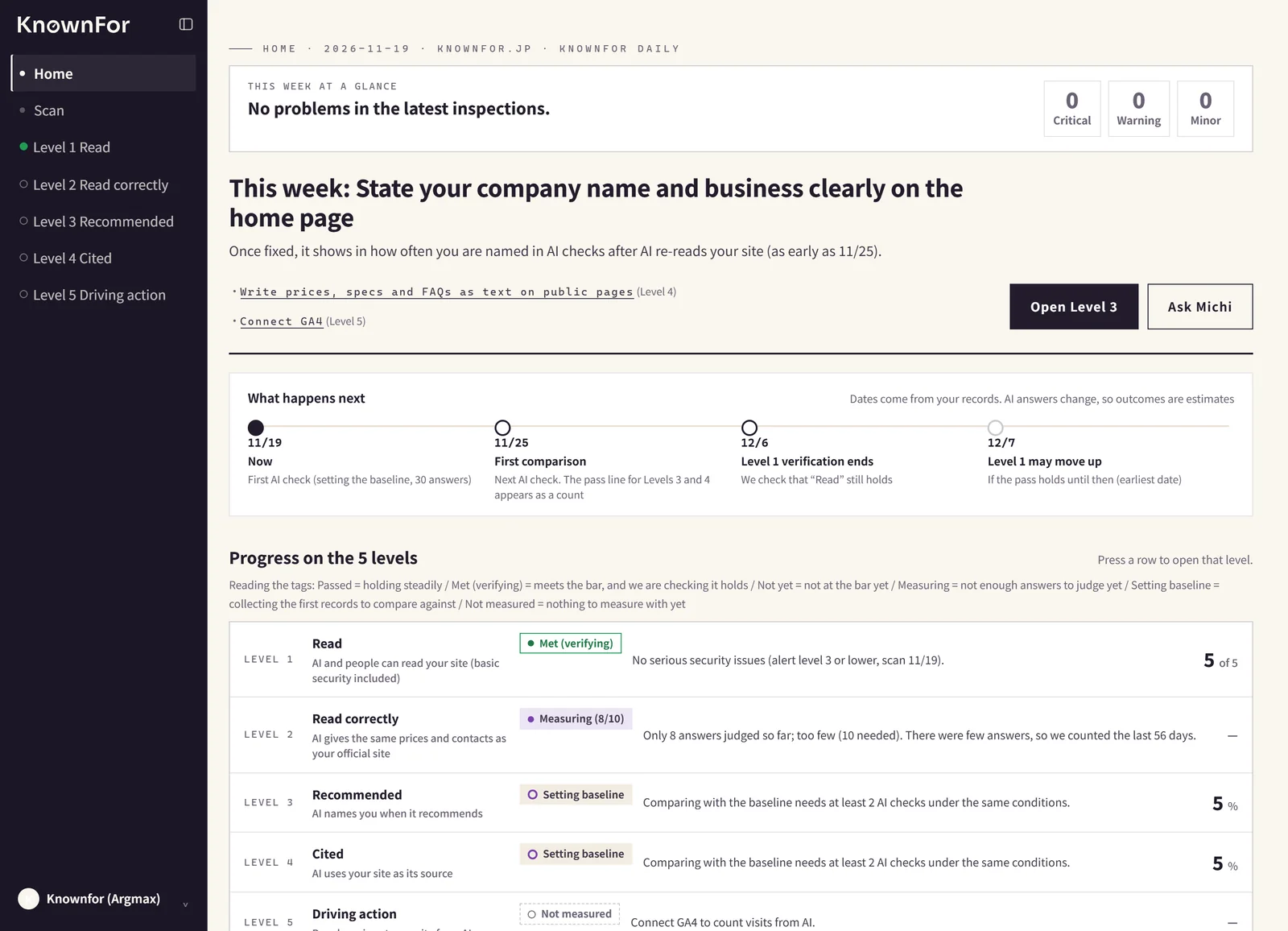
The actual member screen (KnownFor’s own site, knownfor.jp, as of November 4, 2026). Numbers change as records build up.
Sound familiar?Where do I even start?
One next step at a time
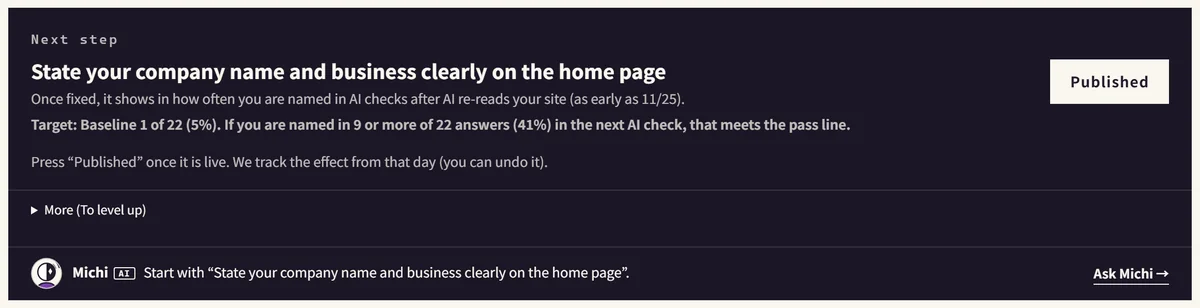
Each level page shows what to do next and the pass mark. Once it is live, press “Published” and the effect is tracked from that day.
Sound familiar?There’s no one I can ask.
A dedicated AI guide for each level
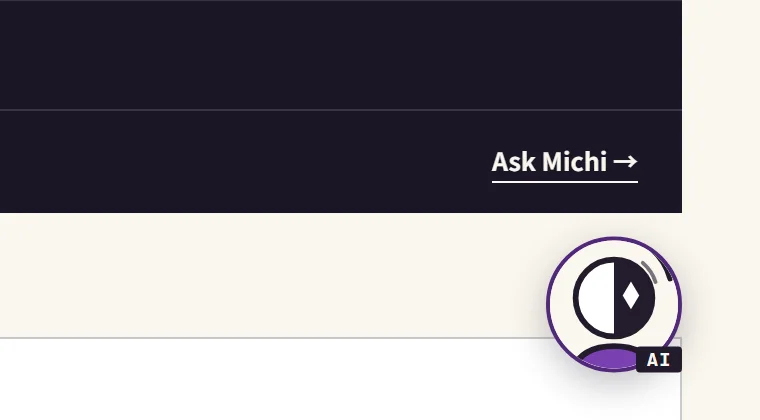
Each level’s screen always shows its AI guide’s icon in the bottom-right corner. Just click it, and the guide answers from your records. Changes are only proposed, and nothing runs until you press “Approve and run”. They are AI agents, not human staff.
Sound familiar?We fixed it. But did it get better?
Before and after, in your records
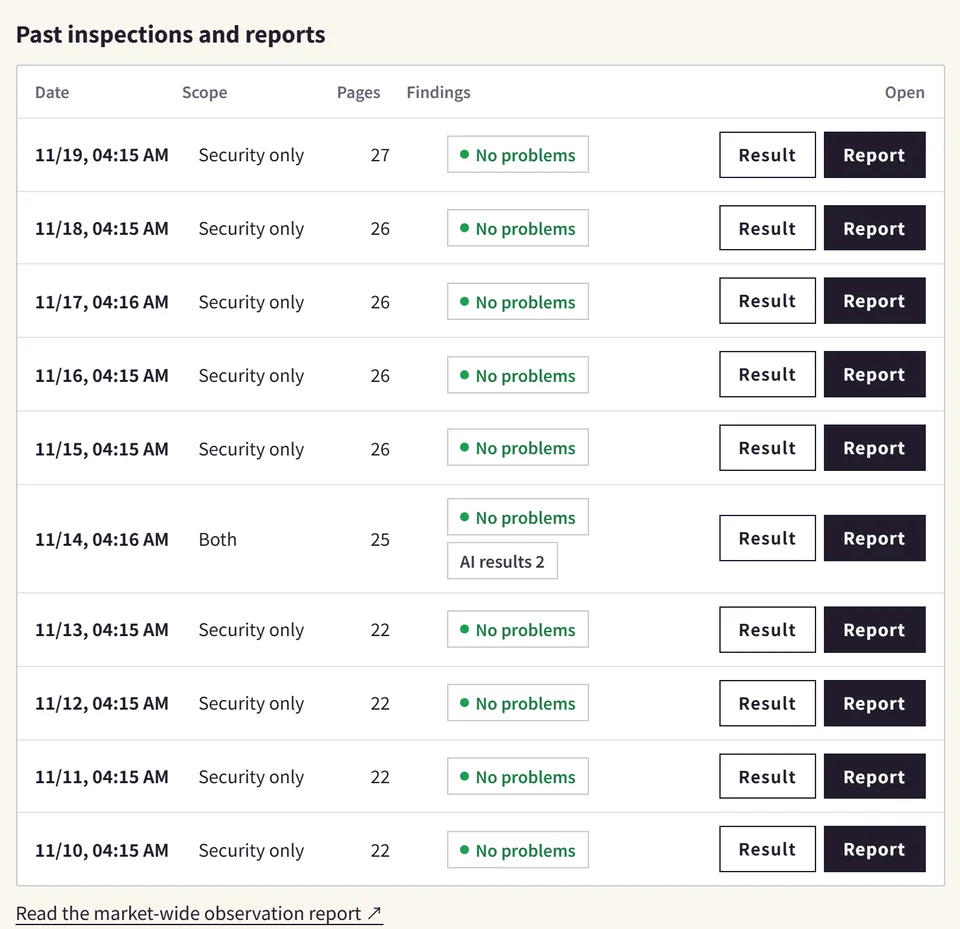
On KnownFor’s own site, 2 critical issues on 10/14 became no problems by 11/4. Every inspection’s results stay on screen. Security checks cover only what is visible from outside and are not a guarantee of safety.
Questions
Frequently asked questions
Can you guarantee my ranking or appearance in AI?
No, we don’t guarantee it. AI’s answers change every time and cannot be decided from outside. KnownFor helps you measure where you are now, narrow down what to fix, and confirm whether your fixes worked.
How do you find security gaps on a site?
We read your site from outside, the same way a customer opens its pages. We check things that can be confirmed from outside: whether the padlock (encrypted connection) is set up properly, whether there is a setting that stops fake emails using your company’s name, and whether old software that is no longer supported is still in use. We measure them the same way every time, much like a health check that measures what can be taken from outside, such as blood pressure and temperature. On owner-verified sites, we also check, by reading only, whether places attackers’ machines often probe (configuration files, database dumps, admin screens and the like) can be read from outside (the attack entry-point check).
For specialistsThe check of settings visible from outside is passive. We read only information anyone can access: responses from public pages, public DNS settings, and public certificate records. Findings come from fixed rules, not AI, so the same input always gives the same result. (For the attack entry-point check on owner-verified sites, see the next question.)
How far does the inspection go? How is it different from a penetration test?
We cover the first three steps of an attack: recon from outside, pinpointing weak spots, and open entry points. Tests that go inside (penetration testing) are in preparation as KnownFor’s next stage. We read pages the same way they are opened, without trying passwords or input fields. We identify ourselves as KnownFor, follow the site’s “please don’t read” rules, and read about as much as a normal visitor would. If the site owner has been verified with a verification mark on the site, we also run the attack entry-point check (website ASM): by reading only, we check whether places attackers’ machines often look for (configuration files, admin screens and the like) can be read from outside, to help prevent data leaks before they happen. For this check only, we read a fixed set of addresses based on the owner’s verification. It is not a guarantee of security, but you get the clues we found and how to fix them.
For specialistsNo active testing (input testing, login attempts, path brute-forcing, TLS handshake probing and so on). Normally we read only linked URLs and fixed public locations (robots.txt, security.txt and the like), identify ourselves in the User-Agent and follow robots.txt. Only for sites whose owner is verified (DNS, file or meta mark), after the inspection we read a fixed set of addresses attackers often probe (/.env, /.git/HEAD and so on) with GET, HEAD and OPTIONS only, without storing the content (KnownFor-SafeCheck; robots.txt is not applied, and removing the mark stops it; Terms Article 8(8)). In ASM (attack surface management) terms, this is the risk-assessment step for fixed locations on this one site; it does not include asset discovery. You can also use it to decide the scope and priorities before a penetration test or vulnerability assessment.
Will you change my site without asking?
No. KnownFor never writes to your site. Any files to place or text to add are approved and published by you (or your web agency).
Which AIs do you look at?
Every subscription plan looks at answers from two AIs, Gemini and ChatGPT (a single inspection asks one AI five questions per product or service, up to three, without naming you). KnownFor decides which AIs to cover, so you don’t need to choose. Connections to Perplexity, Claude, Google’s AI Mode and others are built, and we are checking them against real answers. We will announce it here when they become available.
What do I need to get started?
A work email address and your site’s address (payment by bank transfer or credit card). When you sign up, we read your company name, main product and industry from your site (you can correct them). You can add competitors to compare against later, on screen. Connecting Google Search Console lets us use the words people actually search for. If your site runs through Cloudflare, connecting it also shows AI crawler visits (you can start without connecting either). On your KnownFor screens, the inspection is labelled “scan”.
Can local governments sign up?
Yes. For prefectures and municipalities, we offer a detailed report first, then a fiscal-year contract to keep watching. See our page for local governments (in Japanese).
Can you take us from the inspection all the way to the fixes?
Yes. After your inspection report arrives, you can choose “Get ready up to Level 4” (JPY 150,000 including the inspection, excl. tax, about 4 months) or “To Level 2 (actions and re-inspection)” (JPY 40,000) from your order in your KnownFor screens. You get drafts of the actions to raise your level, ready to hand to your web agency, and re-inspections at set times with the results side by side with before. Your agency makes the fixes; KnownFor does not enter your site. We do not promise that your level will go up (it depends on AI models and outside articles, and effects take months to show). If an error is found, we inspect the same scope again free of charge. With a card we start after payment, with a bank transfer after the payment arrives, and you can cancel until we deliver the drafts.
More questions (15)
How do you decide whether old software or a weakness is urgent?
When we find old software, we compare it with the list of weaknesses that public agencies report as actually exploited. Anything that matches that list goes to the top of the fix list. Software that is merely old is kept separate and ordered after it.
For specialistsWe match the products and versions visible from outside against public vulnerability data and end-of-support data. Priority weighs confirmed exploitation (such as the CISA KEV catalog) above a high severity score (CVSS). Risks are rated on two axes, likelihood and impact, and the scales are printed in the report.
How accurate is it? Could it miss things or get them wrong?
For what is visible from outside, we check with the same yardstick every time. Items we could not confirm are not marked as fine; we write that they could not be judged. Software versions are read from what is shown publicly, so the report says “as displayed” and adds how to confirm.
For specialistsVersions are inferred from banners and the names of served files. Where the display and the actual patch level differ, such as distribution backports, false positives are possible, so findings say “as displayed” and the statement of work includes how to verify. Items whose fetch or name lookup failed are never treated as a pass; they are marked “not judged”. Settings that are intentional can be marked as intended from the next check.
How is this different from GEO or LLMO?
It is the same field. Work to get your products and services named and cited in AI search and generative AI answers is called GEO, LLMO, AIO and so on. KnownFor tracks AI’s answers at regular intervals, measures naming, citations and how you are described, and goes as far as confirming whether your fixes worked. As with SEO, we do not guarantee appearance or ranking.
Does this protect against ransomware?
It is one part of security. Every day we check the outside-visible clues cyber attackers look at first (certificates, security headers, version numbers shown outside, email sender checks and more) and list them in the order to fix. We do not check VPN devices themselves, which are a common way in, or your internal PCs and backups.
What do KnownFor Weekly, KnownFor 3x a week and KnownFor Daily include?
Every plan delivers the same things: weekly inspections and a monthly report, daily security monitoring, the order of fixes and a statement of work, 15 questions about your company asked to AI (Gemini and ChatGPT), your position in AI answers next to companies in your industry, and drafts of page text and settings. Every plan also measures all GEO maturity Levels 1–5. What differs is how many days a week we ask AI about your company (KnownFor Weekly (JPY 40,000/month, excl. tax): once a week; KnownFor 3x a week (JPY 100,000/month, excl. tax): 3 days a week; KnownFor Daily (JPY 200,000/month, excl. tax): every day), and how much you can use yourself for inspections, drafts and consultations on screen (KnownFor 3x a week: 2.5 times KnownFor Weekly; KnownFor Daily: 5 times). AI answers vary from day to day, so asking on more days makes the numbers firmer and changes harder to miss. Usage resets on the 1st of each month. We let you know before you run out, and you can buy more (JPY 10,000, JPY 30,000 or JPY 50,000, or any amount; excl. tax; usable for 6 months from purchase). Once everything is used up, inspections that include AI, drafts and consultations you start yourself stop until it resets (the automatic weekly inspection does not stop). Inspections that include AI are limited to 3 a day; security-check-only inspections have no limit. All cover 1 site and up to 10 products or services per contract, billed monthly, with no minimum term.
How many pages does the one-time inspection read?
One site with up to 3 products or services, for JPY 30,000 (excl. tax, one-time). Anyone can order it, at any time, just once. The price does not change with the number of pages. Checks of site-wide settings (headers, certificate, email settings, CMS version and so on) apply to the whole site regardless of page count. Page-by-page checks cover the important pages first, up to 500 pages. We list the sections and page counts we did not read.
Do you already observe my industry?
We are adding industries step by step. If we already observe yours, you can see results from day one. Even for a new industry, KnownFor sets up observation and shows your first results once enough AI answers are in. We email you when observation starts. We don’t bill until observation starts.
If we sign up as a company, are all our products and services covered?
Yes. One contract is one company and one website, covering up to 10 products or services. Beyond 10, each further 10 is billed at the same monthly fee again. Another company or another website needs a separate contract. We observe each product or service by the name that appears in AI answers (in industries where AI answers with company names, such as machine tool makers, the company counts as one). See also the table in the Pricing section.
What kind of company is this for?
Companies with business products or services that customers choose after comparing several options. If you can update your site within 2–4 weeks, it is easier to confirm the effect.
How can I pay?
Customers in Japan pay by bank transfer as standard (we send an invoice every month), and credit cards are also accepted. Customers outside Japan pay by credit card as standard. The same applies to the one-time scan. All prices exclude tax.
Do I learn nothing between scheduled observations?
You do learn some things. We check every day that what you put in place hasn’t disappeared. If Search Console is connected, we show the day Google re-read your fixed pages; if your site runs through Cloudflare, we show every hour when AI crawlers came to read. Whether AI’s answers themselves changed is confirmed at the next scheduled observation.
How do you count AI crawler visits?
With a read-only key you create in your Cloudflare account, we read only the number of visits and the pages visited by AI crawlers that identify themselves (such as GPTBot). Crawlers that don’t identify themselves can’t be counted. We receive no information about human visitors. The key is stored encrypted and can be removed at any time.
Do you offer onboarding support?
We don’t offer onboarding support by people. On-screen guidance and an AI assistant let you get started on your own. For site fixes, you can hand the request text KnownFor prepares to your usual web agency or the person in charge. If you want the fixes handled too, ask us about having us make the fixes (quoted to fit your site’s build and volume).
Can I pay annually?
Yes. For subscriptions (KnownFor Weekly, KnownFor 3x a week and KnownFor Daily), paying for 12 months at once saves you 2 months (KnownFor Weekly JPY 400,000/year, KnownFor 3x a week JPY 1,000,000/year, KnownFor Daily JPY 2,000,000/year, excl. tax). If you cancel partway through the year there is no refund, but you can stop the next year’s renewal from the screen.
How do I cancel?
You can cancel at any time from the screen. With monthly billing, there is no minimum term.
APPLY
Sign up
Choose a plan in the “Pricing and sign-up” table above. On any plan, all you enter is your website address and email address (we read your company details from your site), with no login. For questions, please see frequently asked questions.
CONTACT
Contact us
For questions or consultations, please use this form.